KS3
Chemical Reactions
Chemical reactions happen around us every day.
When two or more substances combine, a new substance is formed. Learn how these reactions happen in more detail below.Â
Rearrangement of atoms
In some cases, it is easy to tell a chemical reaction is making new products as a colour change, smell, or effervescence (bubbling) might occur. Other chemical reactions are far more subtle, and we need tools to know what is happening.
Chemical Reactions
A chemical reaction creates new products and is harder to reverse.
For example, Hydrochloric acid reacts with Sodium to produce Sodium Chloride and Hydrogen.
The balanced formula equation for this is:
2HCl + 2Na → 2NaCl + H2.
Physical Reactions
A physical reaction creates no new products and is easy to reverse. When water (in its liquid state) solidifies, a state change occurs, and the water is now in its solid form, but it is still H2O.
Using chemical formulae and equations
There are two ways to write any equation. The first is a word equation, and the second is a formula equation. There are always reactants and products in chemical reactions. Reactants are found on the left of the arrow, and the products are found on the right side of the arrow.

Word Equation
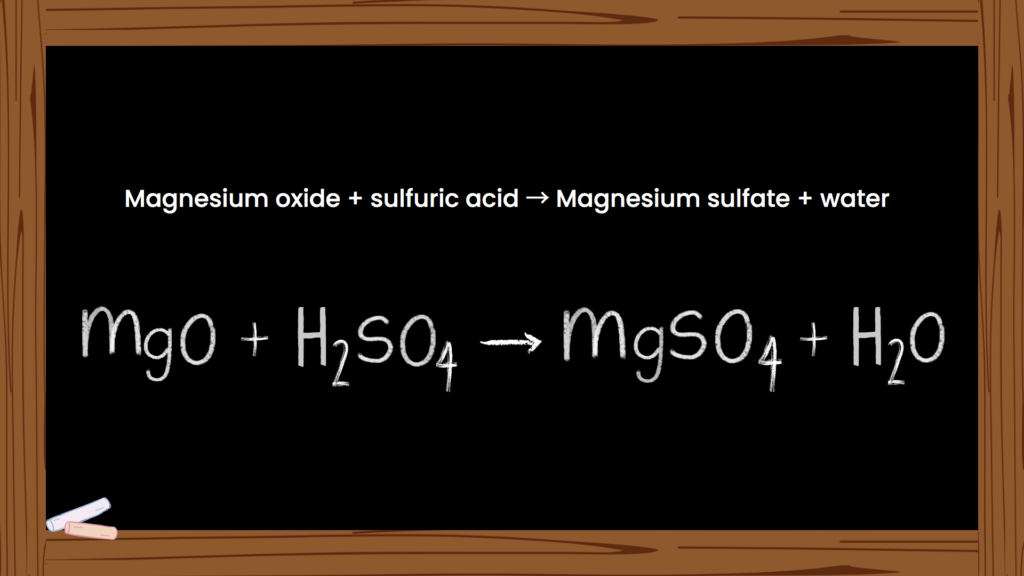
A word equation uses the names of the compounds involved. For example:
Magnesium oxide + sulfuric acid → Magnesium sulfate + water.
Formula Equation
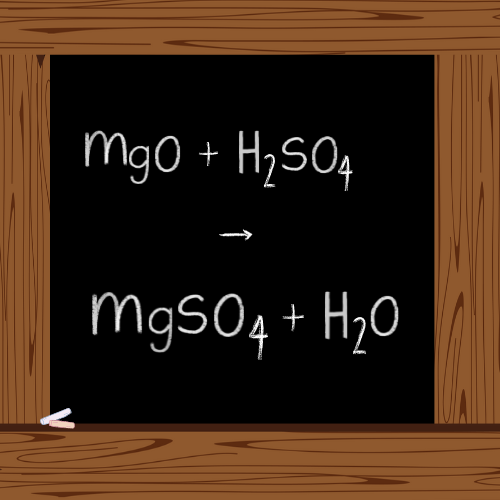
Magnesium oxide reacts with sulfuric acid to produce Magnesium sulfate and water, the formula equation for this is:
MgO + H2SO4 → MgSO4 + H2O
Compounds
On the periodic table, there are the names of each element, but there is also its unique elemental symbol. For example, Lead is Pb, and Potassium is K.
A compound has its own unique formula. This is because a compound is two or more different elements chemically bonded together. An example of this would be Sodium Chloride (table salt) having the formula NaCl, or Copper Sulfate being CuSO4.
Combustion
Combustion is the burning of a substance to produce thermal energy by reacting a fuel with oxygen (O2).
For combustion to take place, you must have the following, fuel, oxygen (O2), and heat. If one of these three things is missing, combustion cannot occur.
Combustion is a chemical change as new chemicals are produced. This can be shown in a word or formula equation.
Combustion word equations
Combustion is a chemical change as new chemicals are produced. This can be shown in a word or formula equation.
Water (H2O) is always produced during combustion, and most of the time, carbon dioxide (CO2) is as well.
The following word equation is used when methane (CH4) is burned in oxygen (O2).
Methane + Oxygen → Carbon dioxide + water
The balanced formula equation is:
CH4 + 2O2 → CO2 + 2H2O
Thermal decomposition
Thermal decomposition is another example of chemical reactions.

What does thermal mean?
When breaking the phrase down, thermal means 'heat' and decomposition means 'breaking down'. This means that thermal decomposition is the breaking down of compounds using heat.
Bicarbonate of soda
When baking a cake if you use bicarbonate of soda (which breaks down to produce carbon dioxide) it makes the cake rise.
Bicarbonate of soda is also called sodium bicarbonate.
The word equation is:
Sodium bicarbonate → Sodium carbonate + water + carbon dioxide.
The balanced formula equation is:
2NaHCO3 → Na2CO3 + H2O + CO2
Thermal decomposition reactions are endothermic reactions. This means they absorb energy from the surroundings.
Oxidation
Oxidation is a chemical reaction when an element or compound gains Oxygen.
A metal such as Aluminium will be oxidised and become Aluminium oxide.
The word equation for this is Aluminium + Oxygen → Aluminium Oxide.
Oxidation
The formula equation for this is,
4Al + 3O2 → 2Al2O3.
Combustion is also an example of oxidation as the fuel reacts with oxygen to produce energy.
Displacement reactions
Displacement is another word for switching. A less reactive element gets displaced by a more reactive one during a displacement reaction. A metal such as Lithium will react with Copper sulfate to form Lithium sulfate and Copper because Lithium is more reactive than Copper.
The displacement list shows Potassium at the top which means it will displace everything below it. All metals should be on the list, but there isn't enough room
Word equation
The word equation for this is:
Lithium + copper sulfate → Lithium sulfate + Copper
When Lead gets added to Aluminium nitrate, there will not be a displacement reaction as Aluminium is the more reactive metal. All the metals on the periodic table are in the reactive series, ordered with the most reactive at the top and the least reactive at the bottom.
Non-metals
Non-metals can also displace each other. When reacting Chlorine with Potassium bromide, a displacement reaction occurs, producing Potassium chloride and Bromine. The word equation for this is:
Chlorine + Potassium bromide → Potassium chloride + Bromine.
The balanced formula equation for this reaction is:
Cl2 + 2KBr → 2KCl + Br2
Metal oxide
Carbon is cheap and is used to extract metals from metal oxides when the metal is lower on the reactivity series than carbon.
The metal oxide (in most cases an ore) gets heated with carbon in a blast furnace, producing a pure metal and carbon dioxide (CO2).
Any metal that is more reactive than carbon gets extracted using electrolysis.
What catalysts do
Catalysts are substances designed to speed up the rate of a chemical reaction without being affected by the chemical reaction. When 10 grams of catalyst get added to a chemical reaction, once rinsed and dried, 10 grams of catalyst will still be present.
Elephants toothpste
Hydrogen peroxide (H2O2) on its own will break down to produce water (H2O) and oxygen (O2), but this takes a long time.
An effervescent reaction occurs when Potassium iodide (the catalyst) gets added to the Hydrogen peroxide.
Oxygen gets produced faster due to the addition of Potassium iodide to hydrogen peroxide, and when you add soap and food dye, this creates bubbles.
Biological catalysts
Enzymes are biological catalysts and act in the same way as a catalyst. Enzymes are located throughout the digestive system, helping break large molecules down so the body can absorb them. An example of an enzyme (biological catalyst) is Lipase which breaks down lipids (fats and oils).

