KS3
Pure & Impure Substances
A substance made up of one atom is called a pure substance. When more than one atom is present in a substance it is impure. Find out more below!

What is a pure substance?
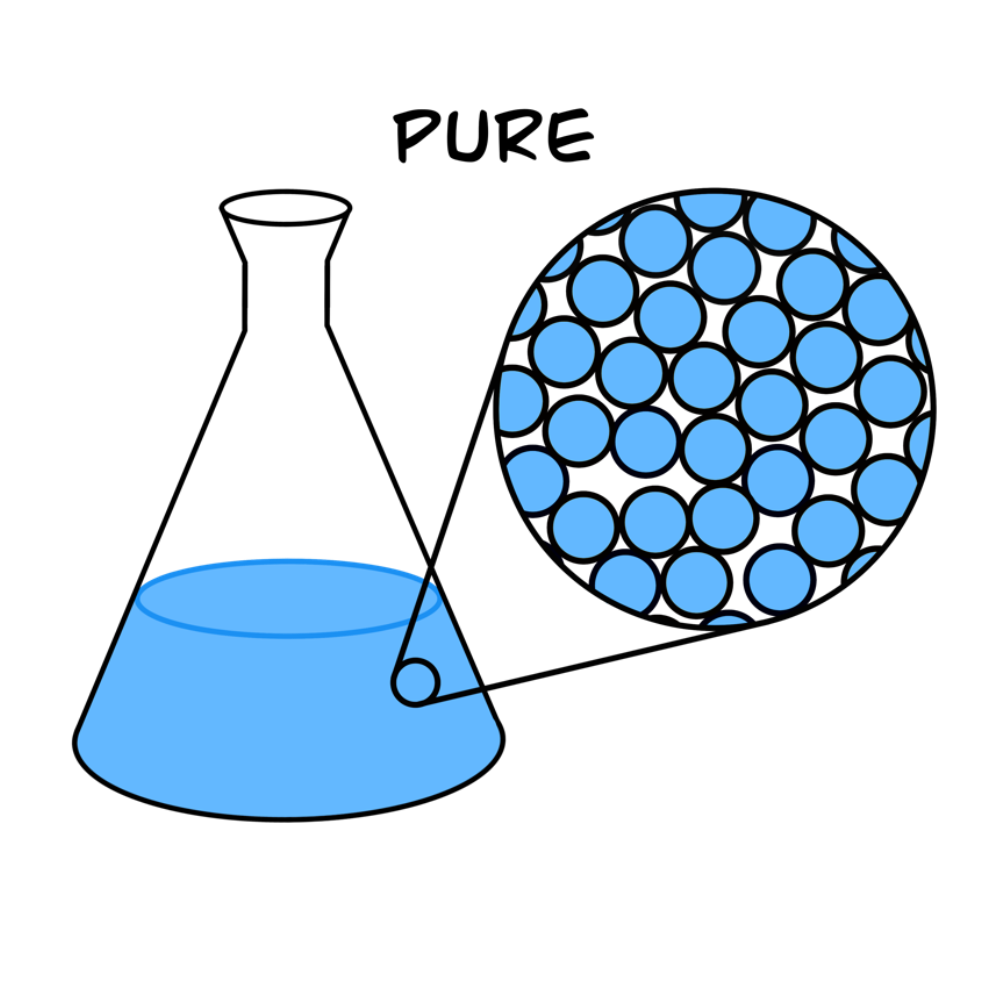
A pure substance consists of only one chemical. This can either be an element or compound. For example the element Nitrogen only consists of Nitrogen atoms.Â
The compound Ammonia (NH3) is a pure substance only consisting of Ammonia molecules. A pure substance has a unique boiling and melting point. For example, the melting point of pure water is 0oC and the boiling point of water is 100oC.
What is an impure substance?
An impure substance (mixture) consists of 2 or more substances not chemically bonded together. Air is a mixture of different gases. Air consists of roughly 78% Nitrogen, 21% Oxygen and 1% all other gases.Â
There are many other examples of mixtures. Some mixtures are easy to see the components (for example cereal and milk). Others are so well mixed you cannot see the components (for example tap water).
Dissolving
When a solid (solute) mixes with a liquid (solute) it becomes a solution we call this dissolving.Â
When a substance has been dissolved we can also refer to this solution as a mixture.
Salt Water Solution
Salt water is an example of this. Sodium Chloride (table salt) dissolves into water to make a salt water solution.
A substance that is able to dissolve is defined as soluble.Â
A substance that is not able to dissolve is insoluble.
Diffusion
Diffusion is the movement of particles from a high area of concentration to a low area of concentration.
Diffusion only occurs in liquids and gases. Diffusion cannot occur in solids.
When in a liquid or a gas state particles move randomly spreading out and colliding until evenly spread out across the whole area.
Filtration
Filtration is used to remove impurities from a solution.
Filtration is used to separate an insoluble solid away from a solution.Â
When filtering the filter will only allow certain size particles to pass through.
The insoluble solid that is too big to pass through is called the residue and gets caught in the filter paper.Â
The solution that might contain soluble substances (for example salt dissolved in water) is able to pass through the filter paper. We call this the filtrate.

Boiling Point
Occurs at a fixed temperature. Takes place throughout the whole liquid. Takes place above the temperature at which evaporation occurs. The liquid forms bubbles. It is a Rapid process. Energy is supplied to the molecules.

Evaporation
Occurs at any temperature. Takes place on the surface of the liquid. Takes place below the boiling point of a substance. No bubble formation. Its a slow process. Molecules get energy from colliding. Not from an external supply.
Crystallisation
We can make pure dry crystals through the process of crystallisation. This can occur by either boiling or evaporating the solvent away from the solute forming crystals.
The longer this takes the bigger the crystals get.
For either process, we can use an evaporating basin, crystallisation dish or a watch glass to produce these crystals.
These pure dry crystals are normally salts.
What is distillation?
Simple distillation is a technique that uses boiling points to separate a solute from a solvent making a substance pure.Â
In many countries distillation is used to get pure water from salt water. We call this potable water (drinking water).
 To get drinking water from salt water this is called desalination.Â
Changing states
When the solution (mixture) is heated the boiling point of the solvent is reached.
It changes state from a liquid into vapour leaving the solute in the flask. The gas (vapour) moves up past the thermometer.
Distillate
The thermometer is positioned next to the side arm to take the temperature reading of the gas.
The gas then passes through the condenser. The condenser cools the gas removing thermal energy.
The gas then condenses back to a liquid.
The liquid is now referred to as a distillate and is pure.Â
What is fractional distillation?
Fractional distillation is a technique used to separate multiple liquids from mixture.
Each of the liquids in the mixture have their own boiling points.
When the mixture gets heated up the liquid with the lowest boiling point turns to vapour and starts to travel up the fractional column.
Condensing vapours
The column at this point is cold at the top and getting warmer at the bottom. The thermometer at the top shows how hot the temperature is for each vapour.
When the vapours travel up the column they condense if the column is too cold. Eventually the column is warm enough for the first liquid to pass into the condenser and become a liquid again.
As the column gets hotter each fraction will get to the top and enter the condenser. Each liquid is then pure and all have been seperated
Chromatography
Chromatography separates soluble substances.
Chromatography has two phases, the stationary phase and the mobile phase.
The stationary phase is the chromatography paper itself.
Mobile phase
The mobile phase is the solvent that moves up through the chromatogram.
An ink-dot is placed on a pencil line. The chromatogram sits in the solvent. The different dyes found in the ink travel at different speeds up the chromatogram. This is then removed and dried.
What does a chromatogram tell us?
If only one single dye moves through the chromatogram it means it's a pure substance.
If multiple dyes move through the chromatogram it means the ink is impure (a mixture).
We can also use chromatograms as tools to compare against other chromatograms. This means if there is an unknown chemical we can compare to known data to find out what it is.

