All metals found on the periodic table get placed in order of reactivity.
The more reactive metal will displace the less reactive metal.
Silver, Gold, and Platinum are found in their native states in the ground, meaning they are taken straight from the Earth, melted, then used straight away.
Carbon is a non-metallic element that can be found in multiple forms.
All known living organisms are carbon-based lifeforms to which carbon (not found as the element carbon) is bound to other elements, such as oxygen and hydrogen. The total mass of these carbon compounds equates to roughly 18% in humans. Carbon is a non-metallic element found in many forms. These giant structures are called graphite, graphene, and diamond.
The use of carbon
Graphite is the only non-metal that can conduct electricity. Graphite is used in pencils and as a lubricant because of its structure. It has layers that can slide over one another.
Graphene is similar to graphite but has only one single layer. Graphene is about 40 times harder than diamond, 200 times stronger than steel, 1000 times lighter than paper, and can stretch by a quarter of its length, making its potential in the future endless.
The use of carbon
The rigid three-dimensional structure makes diamonds extremely hard, allowing them to get used for cutting tools such as drills. Diamonds are transparent (allows light to pass through with ease), making them desirable for jewellery.
Most ceramics get made from clay, which like other materials (used in making ceramics), is soft, malleable and gets shaped easily. When clay gets shaped, it gets put into a kiln, where it is heated. The kiln (reaching temperatures up to 1500oC) changes the clay from a soft, malleable material into a hard, brittle ceramic.
Properties
There are many types of ceramics, such as structural, electrical, refractory, magnetic, abrasives, and glass.
All ceramics have specific properties, such as hardness, heat resistance, strong (under compression), and brittle.
Catalytic Converter
Bricks, like many ceramics, are strong under compression but will brake if dropped or put under too much pressure, just like a plate. Ceramics get used in car parts such as the catalytic converter. The catalytic converter causes a chemical reaction, removing the more harmful chemicals from the exhaust.
Polymers
There are natural and synthetic (manufactured) polymers in the world. Polymers are created by attaching many monomers (single units) in a long chain. A visual representation of this would be having a paperclip and linking more paperclips together to form a chain.
DNA
DNA (deoxyribonucleic acid), proteins and cellulose are all examples of natural polymers. Cellulose (the polymer) consists of a chain of natural monomers called glucose. Proteins get made of natural monomers called amino acids, whereas DNA consists of a monomer called nucleic acid. Keratin is a natural polymer found in hair, fingernails, a rhino's horn, and a pangolin's scales.
Synthetic Polymers
Plastic bags and nylon are both examples of synthetic polymers. Synthetic polymers are also known as plastics, and changing the monomers, changes the properties of the plastic.
All plastics (synthetic polymers) have similar properties, such as,
they are chemically unreactive,
can be moulded,
are solids at room temperature,
are good insulators of electricity,
they don't break down easily (hard-wearing).
DNA
When naming synthetic polymers, we use the name of the monomer and place 'poly' at the start. For example, vinyl-chloride (monomer) chains together to become polyvinyl-chloride (PVC).
Polyvinyl-chloride (PVC) gets used for water pipes and electrical wires as it is hard-wearing, flexible and won't react with its surroundings.
Many clothing items now use Nylon (polyamide), and Elastane (polyurethane) gets used for sports clothing. Elastane is also known as spandex or lycra.
Plastic bags consist of a polymer called polyethene (polythene) which can be strong and hard-wearing.
Plastics
Plastics play a massive role on our planet as they have many uses. Unfortunately, because they are chemically unreactive, disposing of them is difficult, which has become a global crisis/environmental challenge. Plastics are bioaccumulating in living organisms. Plastics are found in the deepest parts of the ocean and in our drinking water as microplastics.
Composites
When two or more materials get mixed, they form a composite material. Composite materials have different properties from the original materials, usually favouring the best parts. When the properties are combined, we refer to this as complementing.
Concrete
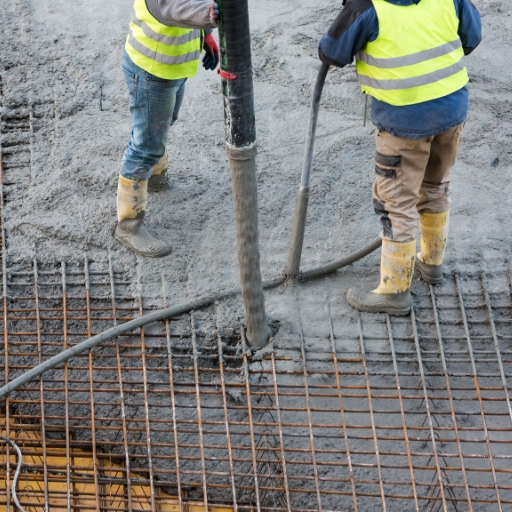
Concrete is a composite consisting of cement, aggregate (gravel and sand) and water. When we change the ratios we can change the use. If steel mesh is added we create the composite reinforced concrete, which can be stretched and squashed.
Carbon Fibre
Carbon fibre (Carbon fibre reinforced polymers or CFRP) is an example of a composite material. Carbon fibre uses a plastic resin that gets baked onto the carbon fabric. This carbon fabric consists of long thin carbon strands bundled together in a woven manner. Carbon fibre is lightweight, strong, and flexible, making it very useful for bicycles, fishing rods, sailboat masts and race car bodies.
Composites
Other composites include
fibreglass (fibreglass reinforced plastic or FRP), which uses resin and fibreglass.
MDF (medium-density fibreboard) is a mixture of wood fibres and glue.
Plywood is strips of wood and glue mixed.