KS3
Humans & the Environment
Looking after our environment is a big responsibility.
In this topic, you will learn about some of the negative effects we can have on our planet.Â
Greenhouse gases
The atmosphere on Earth has many different gases.
Some gases in the atmosphere are Carbon dioxide (CO2), water vapour (H2O), and Methane (CH4).
These three gases are known as greenhouse gases. Greenhouse gases get their name from the similar effect they have on the planet as a greenhouse does on plants and produce.
Causes of greenhouse gases
They trap some of Earth's outgoing energy, and therefore, heat is held in the atmosphere.
The largest production of greenhouse gases come from industrial processes and the burning of fossil fuel.
Deforestation plays another key role in greenhouse gas. With a reduction in trees, the amount of carbon dioxide in the atmosphere increases.
Thermal energy
Thermal energy from the Sun gives life, preventing the planet from being too cold.
Some of the thermal energy gets reflected away from Earth back to space. The thermal energy that's not reflected gets absorbed by the planet's surface.
Geothermal energy
Another kind of thermal energy is geothermal. This comes from the lower layers of the earth's crust. It can be used to generate clean energy.
Hot springs are warmed by geothermal energy. Many animals take advantage of these pools to keep themselves warm.
Earth's energy
Greenhouse gases naturally trap thermal energy keeping Earth at a steady temperature.
Human activity is increasing the volume of greenhouse gases, warming the surface more than it's meant to be. This process is called the greenhouse effect.
Humans carbon footprint
Humans power cars and machines through the burning of fossil fuels. Combustion produces Carbon dioxide, and the levels continue to rise as the population increases.
What is a carbon footprint?
A carbon footprint is a calculation showing the volume of greenhouse gases a person contributes in a lifetime.
These contributions get classified as carbon negative or carbon neutral for example, walking to a location is carbon neutral, and driving a car is carbon negative.
Climate Change
Scientists have now confirmed that the increase in global temperature is linked directly to the human production of greenhouse gases such as Carbon dioxide (CO2), methane (CH4), and water vapour (H2O).
The planet is warming faster than it would naturally, and this is causing problems to occur.
Deforestation
With temperatures increasing, there are more forest fires. Deforestation also contributes to this as there is less moisture produced.
Warmer oceans
The Oceans are getting warmer. This temperature change is bleaching/ killing coral reefs and reducing fish populations.
Rising sea levels
Sea levels are rising due to ice melting faster. Many cities are built next to the sea and will be affected by this.
Effects of global warming
Animals and insects are migrating due to temperature changes making it harder for them to survive. The movement of disease-carrying insects causes more locations to be affected.
Weather is becoming more extreme, with more drought, flooding, heat waves, cold snaps, and storms.
Animals, plants, and other organisms that can't adapt to this rapid change will go extinct.
Bioaccumulation
Human activity has caused vast amounts of pollution to get released into the environment via land, water, and air.
Any harmful or poisonous chemical (toxin) released into a habitat (and causes harm to an organism) gets defined as a pollutant.
Landfill runoff, oil spills, and factory chimneys are ways pollution enters our environment.
Toxins in the food chain
In a food chain, different organisms consume each other. Toxins can enter an organism through being breathed in, the consumption of food, or through its skin.
Not all pollutants can be excreted and so accumulate in an organism. In plants (or other producers), these toxic levels are low enough not to cause a problem.
Primary consumers eat multiple producers, and the toxins in the consumer become concentrated. Bioaccumulation is the gradual increase of none excretable toxins in an organism.
Chemical bioaccumulation
Microplastics, Mercury, and Dichlorodiphenyltrichloroethane (DDT) are chemicals that bioaccumulate.
Mercury
Mercury was used in paint to prevent barnacles from growing on ships and as an insecticide. Mercury bioaccumulates a lot in ocean species causing damage to the nervous and reproductive systems of humans and mammals.
DDT
DDT got used as an insecticide which caused the eggs of birds to become brittle and crack during the incubation period.
Microplastics
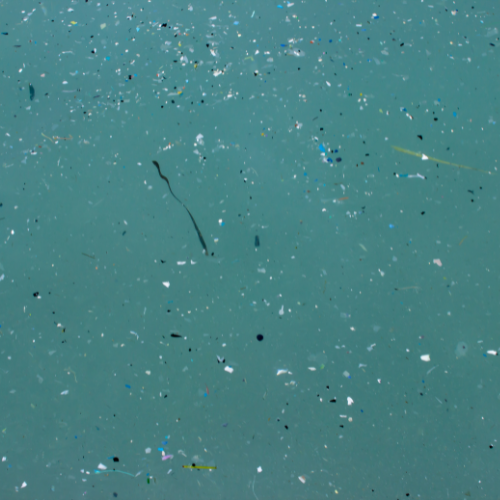
Microplastics cannot be excreted and don't decompose. Microplastics get broken up into smaller and smaller pieces and accumulate in organisms around the globe.
Microplastics can cause death or allergic reactions to occur in cells of the human body.